
Congratulations to Alexis Noel, PhD student from the laboratory, first author of a new study published in npj Science of Food, focusing on the food safety of wheat flours and their contamination by various chemical and biological compounds.
Entitled “Frequent EFSA regulation violation for wheat flours suggests stronger control and regulatory harmonization of production, milling and distribution”, this study was conducted as part of a collaboration involving several French and international research teams. It focuses on a widely consumed staple food—wheat flour—by simultaneously assessing the presence of pesticides, mycotoxins and trace metals in products available to consumers.
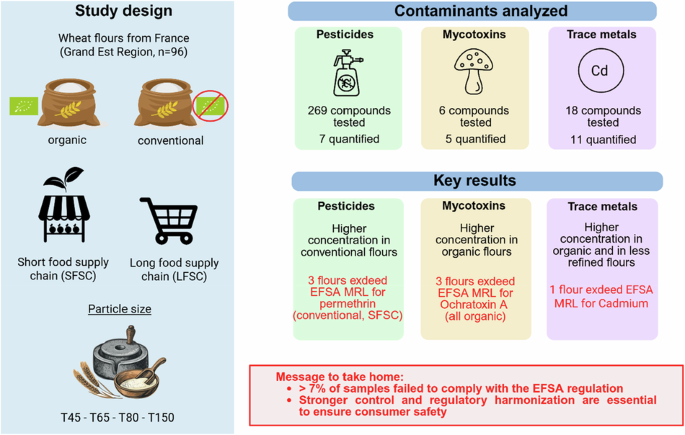
🌾 96 wheat flour samples analysed
The researchers analysed 96 flour samples produced in France and collected from local mills and supermarkets in the Grand Est region. The sampling strategy allowed several factors potentially influencing contamination profiles to be compared, including organic versus conventional farming, short versus long supply chains, and different degrees of flour refinement, ranging from T45 to T150 flours.
The analyses showed that 26% of the flour samples contained at least one pesticide or synergist. In particular, three samples contained permethrin concentrations exceeding the European regulatory threshold considered in the study.
Mycotoxins were also frequently detected: 76% of the analysed flours contained at least one quantifiable mycotoxin. Deoxynivalenol (DON), ochratoxin A (OTA) and zearalenone (ZEA) were among the most frequently detected, with three samples exceeding the regulatory threshold considered for OTA.
The study also investigated 18 trace elements, 11 of which were quantified in the samples. One sample exceeded the European threshold for cadmium. Concentrations of several elements also varied according to farming practices and the degree of flour refinement.
🔎 Findings that raise questions about production and monitoring practices
Beyond the presence of contaminants, the results show that contamination profiles vary according to farming practices, supply chains and the degree of flour refinement. Pesticides were more frequently associated with conventionally produced flours, while mycotoxins and several trace elements were found at higher concentrations in some organic or less refined flours. Multivariate analysis also identified farming type as the main source of variability among the samples.
These findings highlight the value of monitoring several categories of contaminants simultaneously and support the need for stronger controls and greater harmonisation of regulatory practices to improve the safety of cereal-based products.
👏 Congratulations to Alexis Noel on this PhD research and his first-author publication, as well as to all the authors and partners who contributed to this collaborative study!