
A new study conducted in collaboration between ETAP-Lab and the NGERE laboratory, with the participation of Henri Schroeder, has recently been published in Alzheimer’s Research & Therapy. This work explores how aging alters the brain’s vulnerability to amyloid-β oligomers (AβOs), which are involved in the early mechanisms of Alzheimer’s disease.
Understanding why the aging brain becomes more vulnerable
Age is the main risk factor for sporadic Alzheimer’s disease. Among the mechanisms involved in its development, the accumulation of amyloid-β oligomers plays an important role in synaptic and cognitive impairments. However, how aging influences the brain’s response to these oligomers remains incompletely understood.
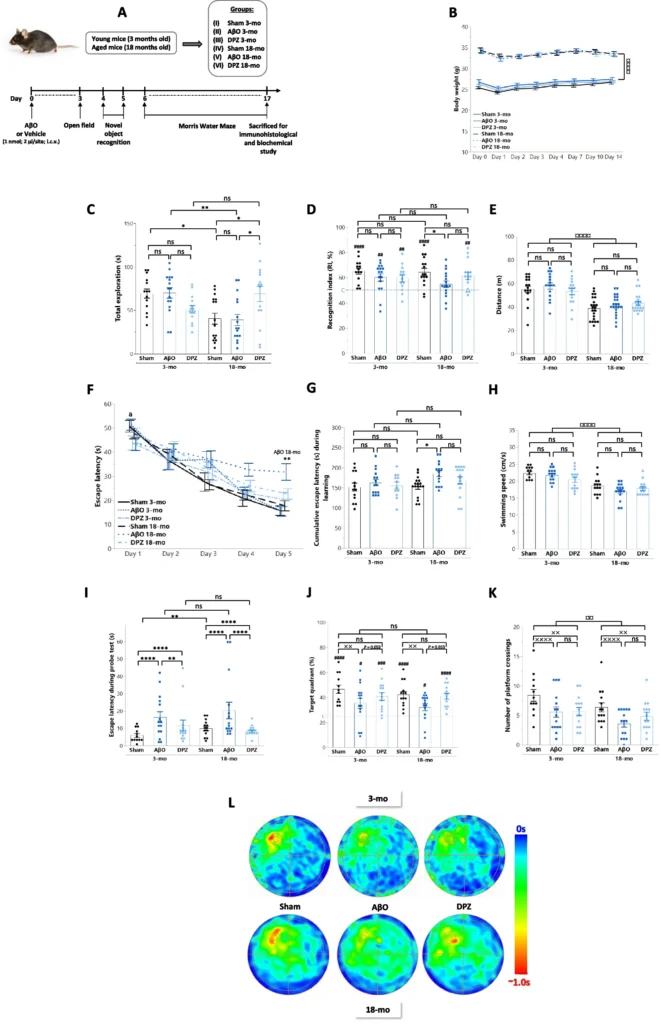
To investigate this interaction, the researchers compared the effects of AβO exposure in young, 3-month-old, and aged, 18-month-old wild-type mice. The study combined behavioral and cognitive assessments with the analysis of markers of synaptic function, neuroinflammation, and apoptosis.
Aging increases vulnerability to amyloid-β oligomers
The results reveal a marked difference between the young and aged brain. In young mice, exposure to AβOs resulted in only mild memory impairments. In contrast, aged mice developed more pronounced deficits, particularly affecting episodic and spatial memory.
At the biological level, aging and AβOs lead to converging alterations: reduced levels of synaptic proteins, increased neuroinflammation, and increased apoptosis. Depending on the brain regions and markers studied, their effects may be cumulative or synergistic, highlighting the particular vulnerability of the aging brain.
A collaboration supporting more relevant preclinical models
This work also illustrates the complementary expertise brought together in this study, notably through the collaboration between ETAP-Lab and NGERE. The findings provide new insights that could help improve the preclinical models used to study Alzheimer’s disease.
Indeed, many experimental models rely on young animals or transgenic models, which do not necessarily reproduce the physiological aging associated with sporadic forms of the disease.
The authors therefore suggest that exposure to amyloid-β oligomers in aged wild-type mice could provide a relevant non-transgenic model for studying the early stages of Alzheimer’s disease and for the preclinical evaluation of new therapeutic strategies.
👏 Congratulations to Henri Schroeder and to all the authors and collaborators involved in this publication!
Référence :
Allouche A., Colin J., Birck C., Schroeder H., Tallandier V., Baldoni M., Muller C., Afrassi M., Violle N. Aging alters the vulnerability pattern to amyloid-beta oligomers in wild-type mice: a behavioral and neurobiological study. Alzheimer’s Research & Therapy. 2026;18:122.
🔗 Read the Open Access article: https://doi.org/10.1186/s13195-026-02051-2