A major advance resulting from research conducted at NGERE has just been published in Science Advances. This study, which represents the main publication from Audrey Malardé’s PhD thesis, explores a new therapeutic strategy based on the use of copper nanoclusters (CuNCs) to treat Menkes disease.
A rare disease with limited therapeutic options
Menkes disease is a rare genetic disorder caused by mutations in the ATP7A gene, leading to severely impaired copper transport throughout the body, particularly to the brain. This deficiency disrupts the activity of numerous copper-dependent enzymes and results in severe multisystem disease, including progressive neurodegeneration.
The currently available treatment, based on the administration of copper-histidine, can improve some peripheral manifestations of the disease, but its limited brain biodistribution restricts its effectiveness against neurological symptoms.
Nanoclusters capable of delivering copper to the brain
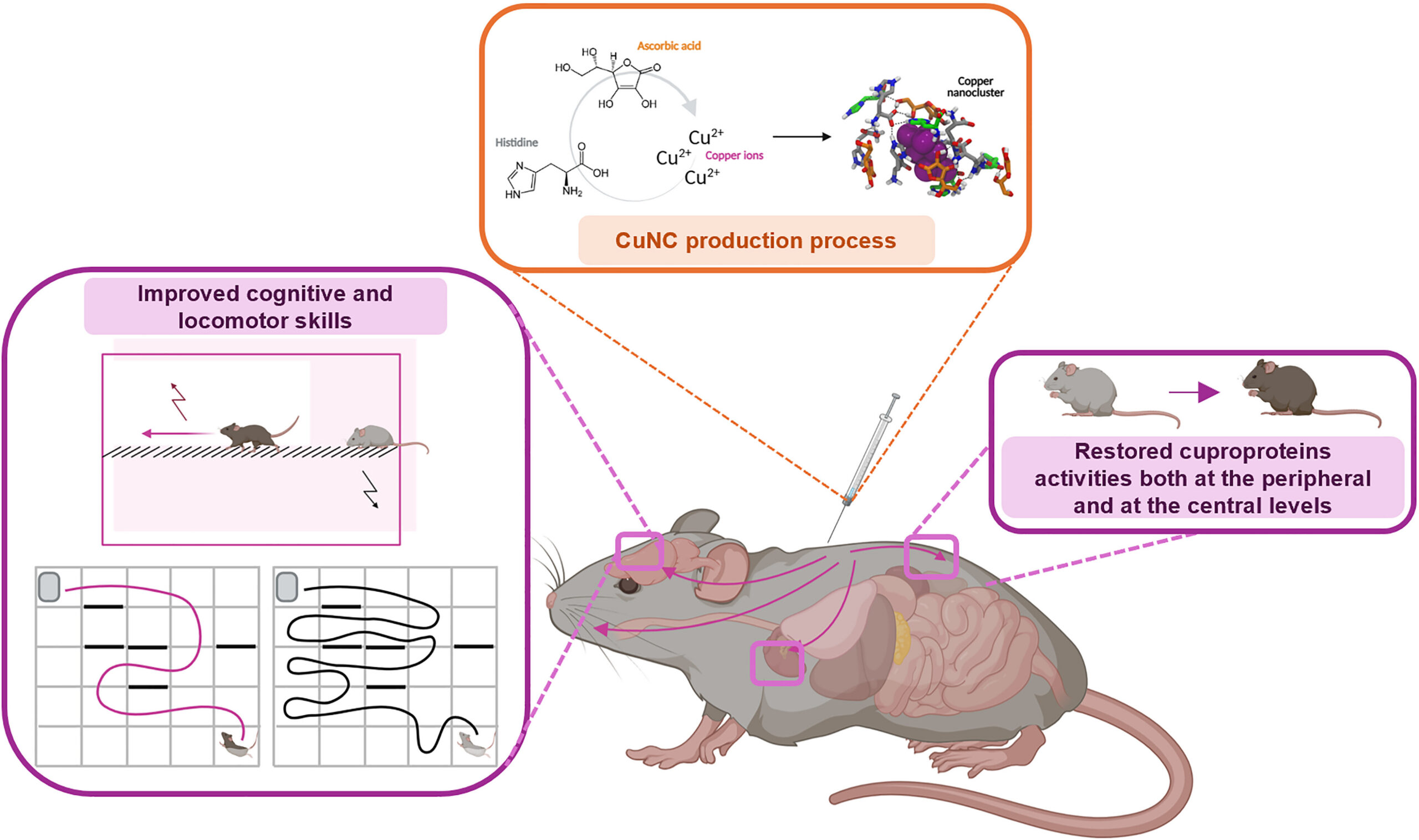
To overcome this limitation, the researchers developed ultrasmall copper nanoclusters, designed to cross physiological barriers, including the blood-brain barrier, and thereby deliver copper to the cells and proteins that need it.
Tested in Mo-blo mice, a model of Menkes disease, these nanoclusters improved copper distribution in several brain regions involved in motor and cognitive functions.
The results are particularly encouraging: treatment markedly improves animal survival, restores the activity of several copper-dependent proteins and leads to significant improvements in neurological functions. In particular, treated animals show restored learning and memory abilities.
From fundamental research to a new therapeutic perspective
These findings open particularly promising avenues for the development of an innovative treatment for Menkes disease, a severe rare disorder for which significant unmet therapeutic needs remain.
This innovation is currently undergoing technology transfer and development with the support of SATT SAYENS. The work has notably led to the filing of an international patent, and the copper nanoclusters have received orphan drug designation from both the European Medicines Agency (EMA) and the Food and Drug Administration (FDA).
This study is also the result of a strong scientific collaboration, notably with Ariane Boudier and Igor Clarot, based on an idea by François Feillet, and the work continues today with Audrey Malardé.
And the story does not end here: other projects involving metal nanoclusters are currently underway or in development, opening up new perspectives at the interface of nanomedicine, metal metabolism and human disease.
Publication:
Audrey Malardé et al., Restoring brain functions in the Mo-blo mouse model of Menkes disease with copper nanoclusters, Science Advances, 2026, 12(40), eaeg6972.
DOI: 10.1126/sciadv.aeg6972